
Trace Copiah County Former Owners
Begin with a current instrument you can verify. Every grantor in that deed becomes the next name to chase as a grantee. Keep the same legal description or parcel clue at each step, and record the filing date, deed type, parties, and book and page.
| Transfer Date | Grantor to Grantee | Deed Type | Book/Page |
|---|---|---|---|
| Newest verified filing | Prior owner to current grantee | Current conveyance | Record the exact reference |
| Next earlier filing | Earlier owner to that grantor | Acquisition deed | Record the prior reference |
| Probate interval | Estate or heirs to successor | Estate deed or order | Log case and deed references |
| Historic interval | Named landholder to successor | Verified deed-book transfer | Archive or courthouse citation |
The Copiah land-record inquiry is a strong starting point. Its fields cover grantor, grantee, instrument, book, page, parcel, legal description, lot, section, township, and range, which keeps prior owners tied to one tract. Try spelling variants, since the portal itself warns that names and indexing may contain errors. Exported results organize your leads. They stay informational until matched against the courthouse index.
Courthouse inspection is open during the posted weekday hours. You can make self-service copies at the county's published per-page rate, or have staff copy them at the higher staff rate. Mail requests require payment, identification, and a stamped return envelope. These routes matter when an older image is missing online or a fragile chain hinges on a page that must be read in full.
Book 7X Anchors Copiah County Owners
One sample parcel cites deed books 7X-487 and 7X-489 in its legal description. It also lists later deed rows. Those book labels travel well. They can be carried straight into the Chancery index. This works even when a rural street address is weak or missing. The source deed inquiry displays the controls used to reconstruct the owner chain.
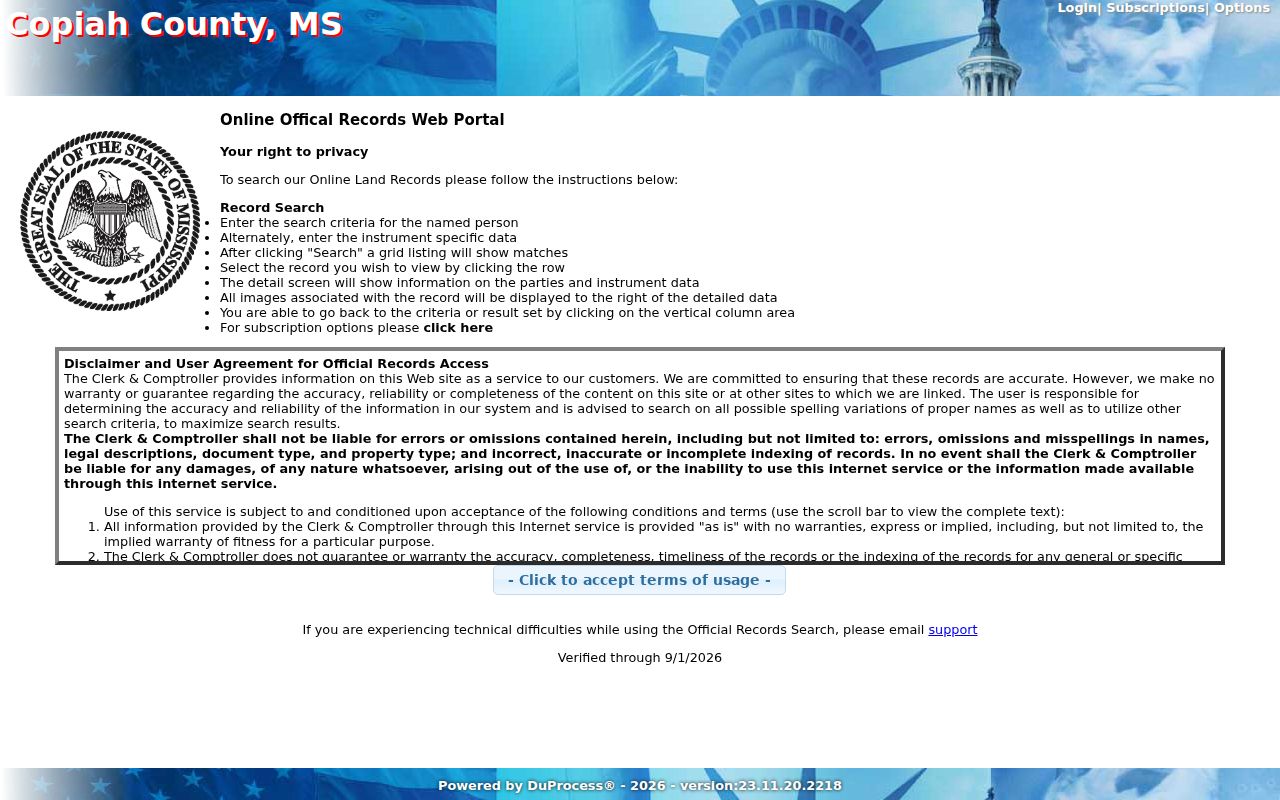
Legal and instrument search fields on the inquiry can explain a gap between previous owners.
Question Copiah's Blank Deed Dates
A sample card may show the two 7X references with a date of 00/00/0000. That display is not a conveyance date. Retrieve the deed by book and page. Then read the filing and execution dates before placing its parties in order.
Note: A 00/00/0000 display cannot establish when a former owner acquired or conveyed the land.
Reconstruct Copiah County's Owner Chain
Move backward one transfer at a time. Parcel numbers help with recent files. Legal descriptions and book references hold up better across long spans, so lean on them for older decades. Each verified grantor becomes one of the prior owners in your working timeline, but never add a name simply because something similar appears in the index.
- Find the current owner's acquisition deed.
- Read its grantor and exact land description.
- Search that grantor as a grantee for the earlier acquisition.
- Repeat and continue in deed books when online results end.
- Grantor
- The party conveying an interest.
- Grantee
- The party receiving it.
- Chain of title
- The ordered sequence of instruments affecting ownership.
- Reverse index
- A route for finding a party in the opposite deed role.
- Quitclaim deed
- A transfer of whatever interest the grantor holds, without warranty promises.
Bridge Copiah Probate Transfers
A former owner may pass land through an estate rather than a sale. Search the decedent, executor, administrator, heirs, and legal description. The Chancery Clerk holds wills, estates, guardianships, conservatorships, and related land instruments. The office also offers in-house genealogical searches. A name can surface in a court file. This can happen long before the next conveyance appears in the deed chain.
A will alone may name an heir without completing the parcel trail. Look for a court order. Search also for an executor or administrator deed, an heirship instrument, or a partition. Add a distribution or a later deed. Compare the land description in each item. A death certificate establishes event information under its access rules, but it does not itself convey title. The chain should resume with the instrument that actually links the estate or heirs to the next owner.
Use Copiah County Former-Owner Tax Books
The MDAH assessment series includes combined 1823-1841 material and separate land years through 1875. These volumes can locate landholders before PPIN and PARID existed. The archive also lists personal-property and tax-collector runs. So confirm the volume is a land assessment before treating a name as a property lead.
An assessment entry is a lead, not a deed. Pair the name and land context with deed books, court files, or a plat. Comparing consecutive tax years narrows a useful window. It shows the point at which one assessed name gave way to another. That window can guide a grantor-grantee search. But it cannot prove the date or terms of a transfer. Only the relevant instrument can do that work.
Search Copiah County Owner Instruments
The inquiry lists deeds of trust, discharges, construction and federal tax liens, lis pendens, oil and gas filings, old maps, plats, powers of attorney, and will books. Corrections, assignments, releases, trustee instruments, and mineral or timber filings may explain an apparent break. Search only the generic deed volume. It can hide the paper that clarifies a former owner's role.
Not all of these records convey ownership. A deed of trust usually secures debt. A release may clear it. A power of attorney may explain who signed for a party. Read each instrument's function. Keep the legal description tied to the chain throughout. A correction may change a name or description. Retain both the original and corrective references in the timeline.
Continue Copiah County Owners Offline
The online index is only a starting point. A long ownership chain rarely ends there. The Chancery Clerk lets the public inspect land records during posted weekday hours. Self-service copies run $0.25 per page. Staff copies cost $0.50 per page. Certification carries an added fee the county has not published. Mail requests should include a check or money order. Add reasonable identification and a stamped return envelope. Always cite the exact book, page, party, and land description.
Once the courthouse trail leads into older material, MDAH matters. Its Copiah finding aid covers original records, courthouse microfilm, and digital series. You request original county items through the reading room. Microfilm sits in the Media Room for self-service. Holdings span early land examples, court records, tax-collector books, assessment series, and pre-1920 inventories. Read catalog labels with care. An abstract book or account book is not automatically a deed book.
Other sources can narrow a date without replacing a conveyance. The FamilySearch catalog lists Copiah voter registers from 1876 through 1923 by precinct and place. Historic newspapers may carry sale, estate, road, or business notices. Treat these as clues. Use them for a party, a date range, or an old place name. Then return to the recorded deed, probate order, or plat. A former owner belongs in the chain only when the land and instrument align.
Keep a research log with one row per verified transfer. Record execution and filing dates when the deed supplies both. Note gaps plainly instead of guessing. A clean gap statement beats filling years with substitutes. Tax rolls, directories, or newspaper references show association but not title.
How Far Back Copiah County Owners Go
Copiah County formed in 1823. The Clerk describes genealogy searches reaching from formation to the present. That promise does not prove every volume survives or sits online. The system minimum of 8/23/1800 is no proof that Copiah coverage begins then. No clean published imaging cutoff exists. State that uncertainty in any ownership timeline. The Copiah County Records Portal source displays the notice. It separates online discovery from the official courthouse index.
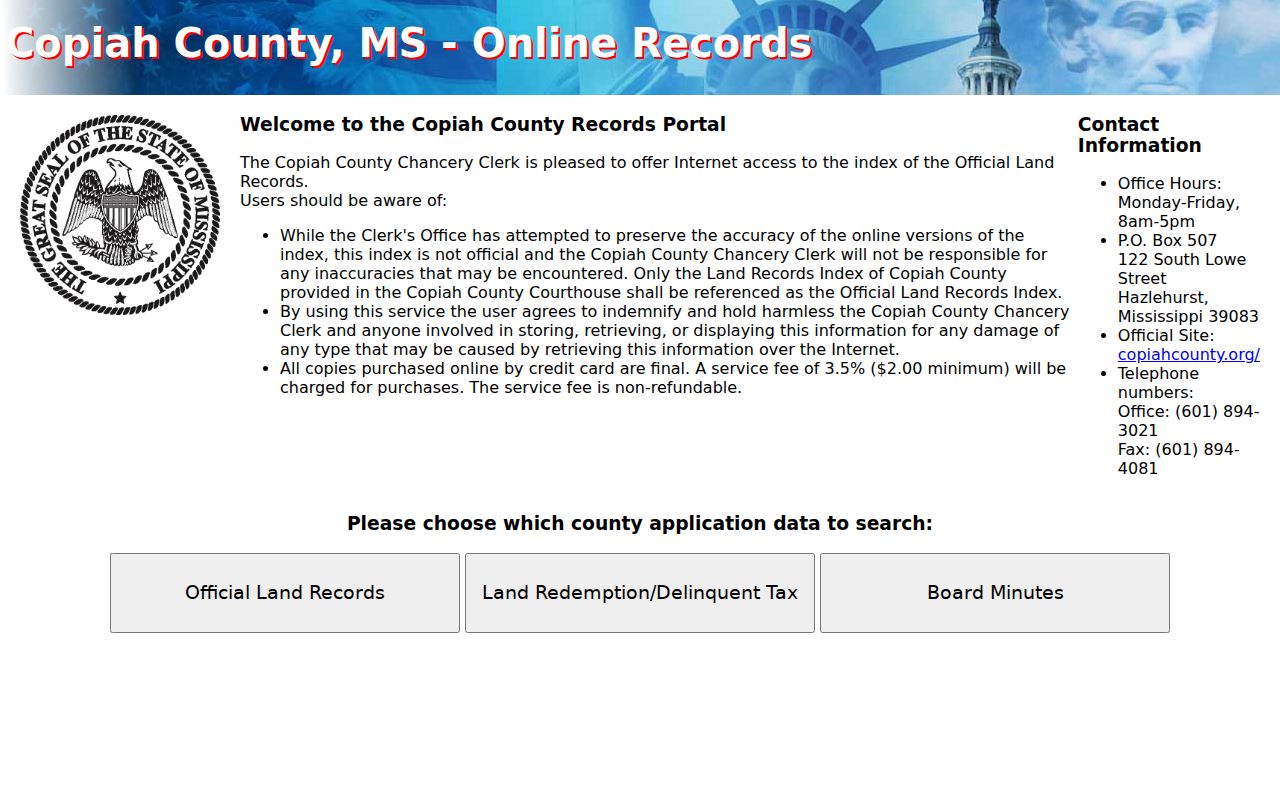
That official notice is why a long former-owner chain should keep its online findings. But verify decisive book and page entries at the courthouse.
When online results stop, turn to the official courthouse index, MDAH finding aids, originals, and microfilm. MDAH lists early land examples and court microfilm. Its reading room handles original county material. For a single recorded instrument rather than a full chain, see Copiah County deed records.
Historic plats can solve a place-name break. The Crystal Springs Copley House nomination points to the Stowell Map and John F. Tillman Subdivision, lot 1. Use such a name as a catalog and index term, then locate the recorded plat. A preservation nomination gives context, not the official boundary or ownership chain.
Coverage caution. Do not treat the software's 1800 date as a deed cutoff. Verify older prior owners through books, microfilm, and archive citations.